Home › Explainers › Atmospheric angular momentum
Atmospheric angular momentum (AAM)
Also called: AAM, relative AAM, global atmospheric angular momentum, Global Wind Oscillation, GWO, length of day
Atmospheric angular momentum (AAM) is the atmosphere's total spin about the Earth's axis. Its relative part, the one carried by the winds, is
$$M_r = \frac{a^3}{g}\iiint u\,\cos^2\!\phi\;d\lambda\,d\phi\,dp$$
the mass-weighted westerly wind, weighted again by the distance from the axis. The mass term, $\Omega a^4 g^{-1}\iint p_s\cos^3\!\phi\,d\lambda\,d\phi$, is the angular momentum the atmosphere carries by rotating with the Earth, and shifts only as air mass moves between latitudes.
What moves it
- The subtropical jets dominate the total. The $\cos^2\phi$ weight is largest at the equator, but the deep tropics hold weak or easterly winds, so they add little to the total while dominating its variability: a small change in the trades acts over a huge area at the largest weight.
- El Niño raises AAM. It strengthens the subtropical jets and weakens the trades, so the atmosphere holds more westerly momentum. Conservation then requires the solid Earth to slow down: AAM anomalies appear as changes of a fraction of a millisecond in the length of day, and about 6×1025 kg m2 s−1 of AAM corresponds to one millisecond.
- It can change only through surface torques, the mountain and friction torques. Mountain torque works within days; friction over weeks.
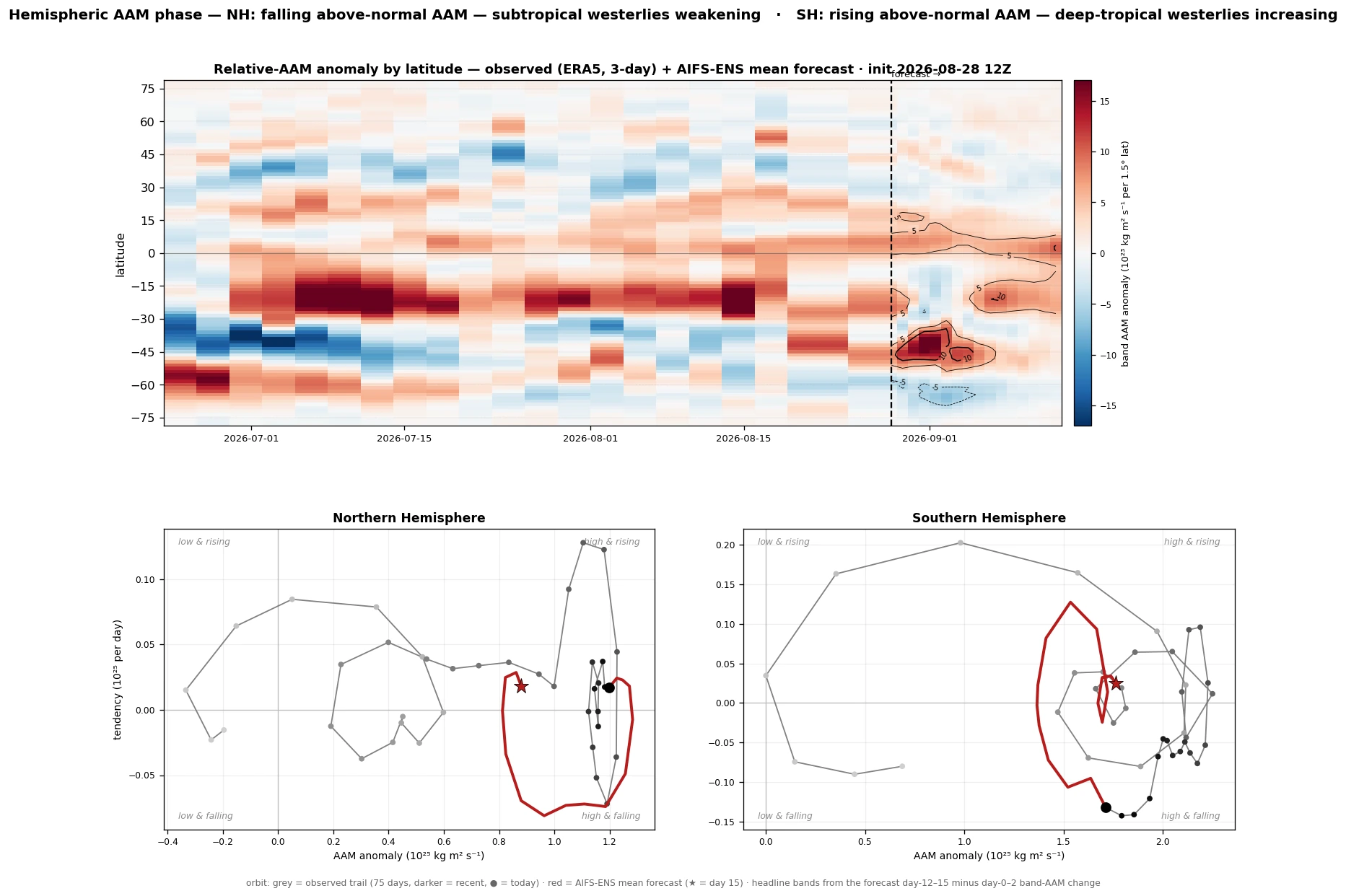
- The Global Wind Oscillation (Weickmann and Berry, 2009) follows the global AAM anomaly against its tendency in a two-dimensional phase space, much as the MJO index follows tropical convection. Orbits through it pass through the same sequence of jet and torque patterns in each subseasonal cycle.
The live forecast
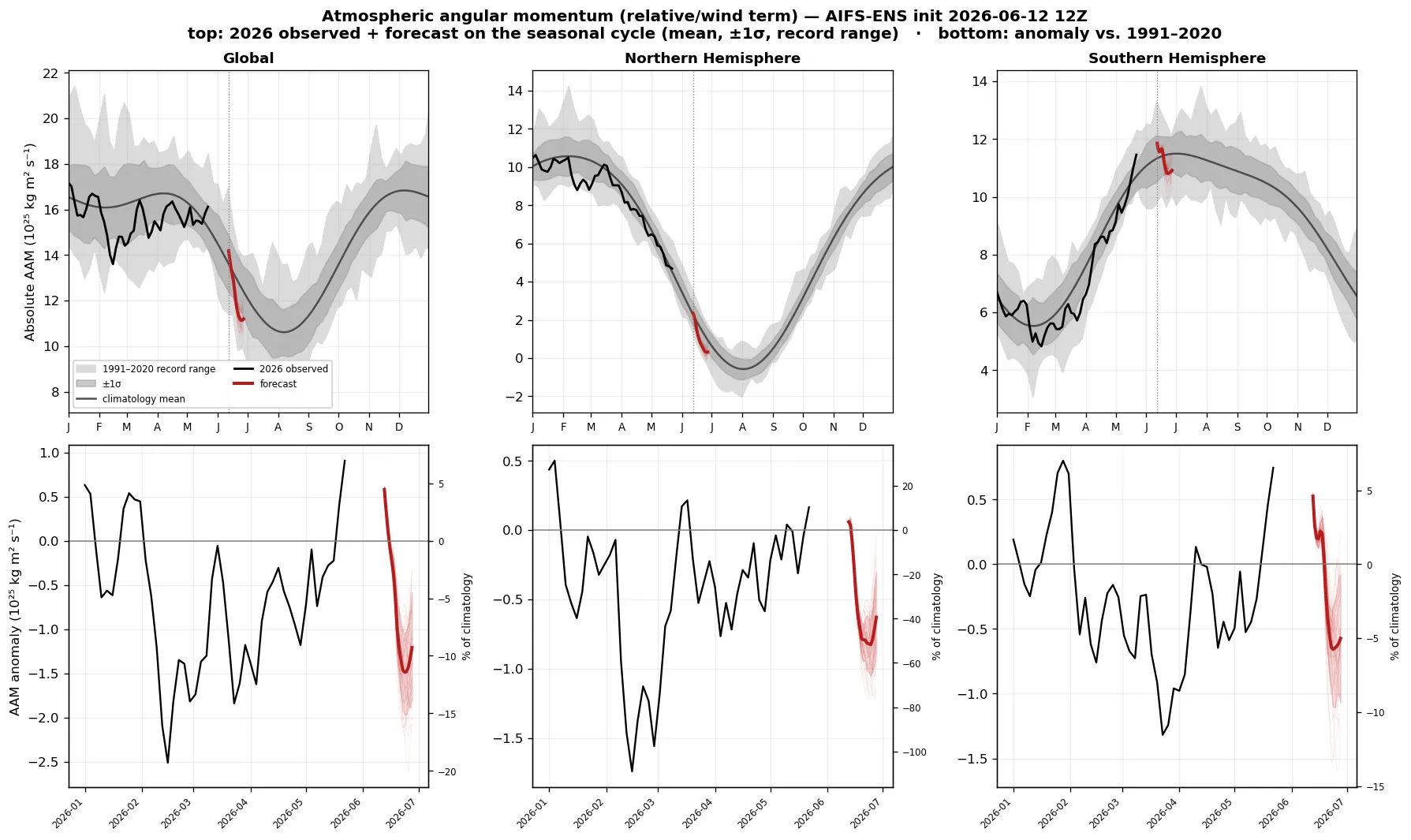
Relative AAM is integrated for the globe and each hemisphere from the ECMWF AIFS ensemble's winds on 14 pressure levels from 10 to 1000 hPa, which is effectively the whole column. It is shown on the ERA5 1991–2020 annual cycle together with the 15-day forecast. GFZ's ESMGFZ series, computed from ECMWF analyses for the Earth-rotation community, is drawn alongside as an independent check. The phase plot follows each hemisphere through AAM anomaly against tendency: the hemispheric version of the Global Wind Oscillation.
Open the AAM product in the circulation viewer