Home › Explainers › Mountain torque
Mountain torque and friction torque
Also called: mountain torque, friction torque, frictional torque, surface torque, torque budget, atmospheric angular momentum budget
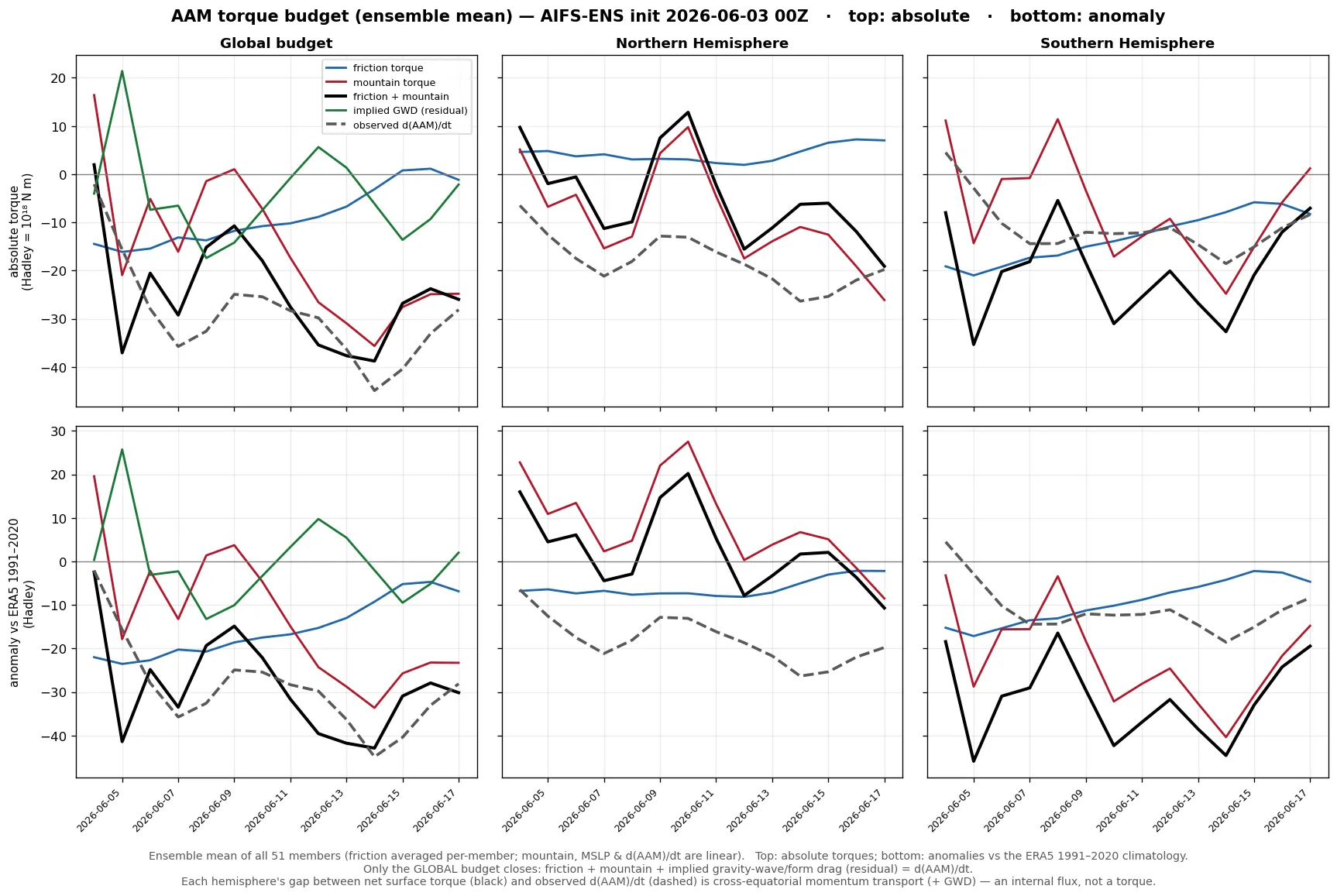
The atmosphere's angular momentum about the Earth's axis changes only through torques exerted at the surface. Three act: friction torque, the drag of the surface on the wind; mountain torque, the pressure difference across mountain ranges pushing on the topography; and the gravity-wave drag torque from terrain too small for a model to resolve. Whatever angular momentum the atmosphere gains, the solid Earth loses, which is why atmospheric angular momentum tracks the measured length of day.
The equations
$$\frac{dM}{dt} = T_F + T_M + T_{GW}$$
$$T_M = -a^2\!\iint p_s\,\frac{\partial h}{\partial\lambda}\,\cos\phi\;d\lambda\,d\phi = a^2\!\iint h\,\frac{\partial p_s}{\partial\lambda}\,\cos\phi\;d\lambda\,d\phi$$
$$T_F = a^3\!\iint \tau_\lambda\cos^2\!\phi\;d\lambda\,d\phi$$
Here $M$ is the atmosphere's angular momentum, $p_s$ the surface pressure, $h$ the surface height, $a$ the Earth's radius and $\tau_\lambda$ the eastward surface stress acting on the atmosphere. The two forms of $T_M$ are equal by integration by parts around each latitude circle. Torques are quoted in Hadleys: 1 Hadley = 1018 N m.
How to read it
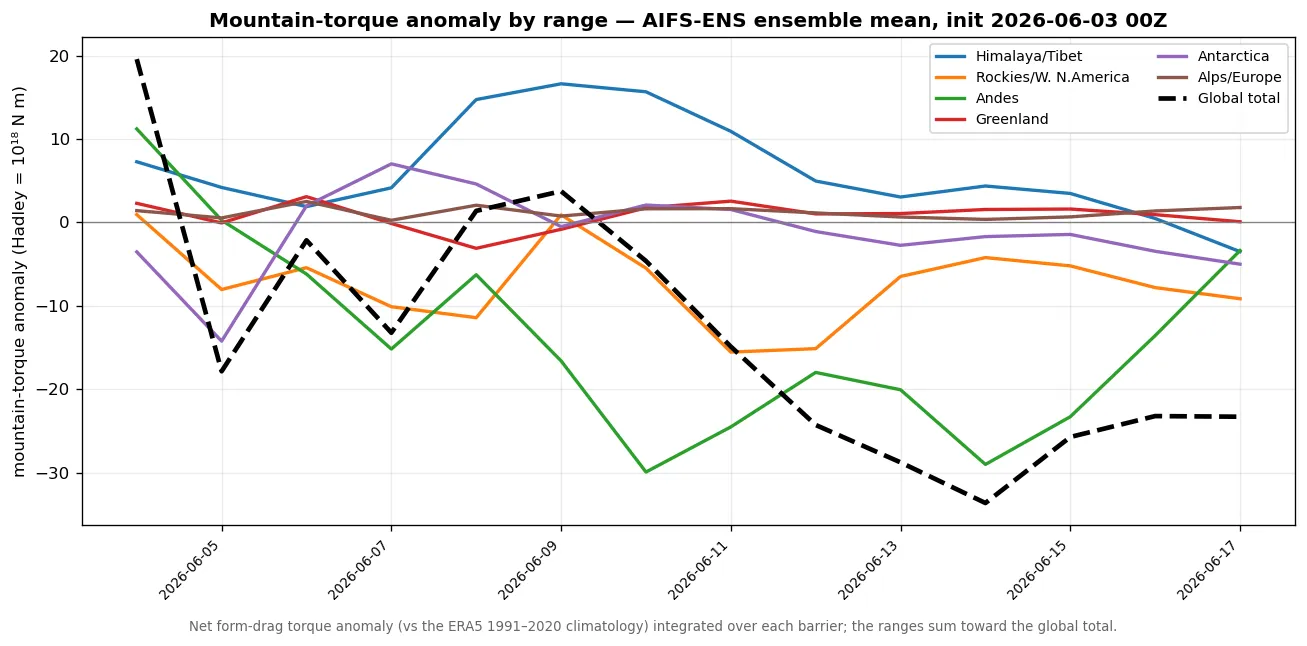
- Mountain torque: high pressure on the west side of a range and low pressure on its east side pushes the mountain eastward, so the mountain pushes the atmosphere westward. The atmosphere loses westerly momentum; this is a braking event. The reverse pattern (low to the west, high to the east) adds westerly momentum. Because the pressure pattern moves with the weather, mountain torque changes within days, and the Rockies, the Tibetan Plateau and the Andes carry most of it.
- Friction torque follows the surface winds: the easterly trade winds gain westerly momentum from the surface, and the mid-latitude westerlies lose it. It changes more slowly, over weeks, as the wind belts shift.
- Large mountain-torque events tend to come before changes in the jet downstream and in the global angular momentum. On this site's own test (ERA5, 1991–2020), strong Himalayan torque days are followed about five days later by a stronger jet exit over the North Pacific.
The live forecast
The friction and mountain torques are computed from the ECMWF AIFS ensemble for days 0–15 as anomalies from the ERA5 1991–2020 climatology for the same time of year. Anomalies are used on purpose: the absolute budget cannot be closed. ERA5's own terms sum to −4.5 ± 0.7 Hadleys in the annual mean where the answer must be zero, and the resolved mountain torque changes with grid spacing. Both errors sit in the mean and cancel in an anomaly. The open forecast data carry no gravity-wave stress, so that term stays in the residual between the net torque and the actual change in angular momentum.
Open the surface torque product in the circulation viewer