Home › Explainers › Eddy heat flux
100 hPa eddy heat flux
Also called: eddy heat flux, meridional eddy heat flux, v'T', vT 100 hPa, upward wave activity, vertical E-P flux
The zonal-mean poleward eddy heat flux $[v'T']$ at 100 hPa is the most direct measure of how much planetary-wave activity is leaving the troposphere for the stratosphere. It is proportional to the vertical component of the Eliassen–Palm flux, $F^{(z)}\propto f\,\overline{v'\theta'}/\bar\theta_z$, so a large positive value means waves are propagating upward into the polar vortex.
Why amplitude is not enough
A large planetary wave is not necessarily moving upward. A wave that is vertically stacked carries almost no heat flux; one whose ridges and troughs tilt westward with height carries a lot. Maps of wave amplitude show where the wave sits, and the heat flux shows whether it is going up.
How it leads the vortex
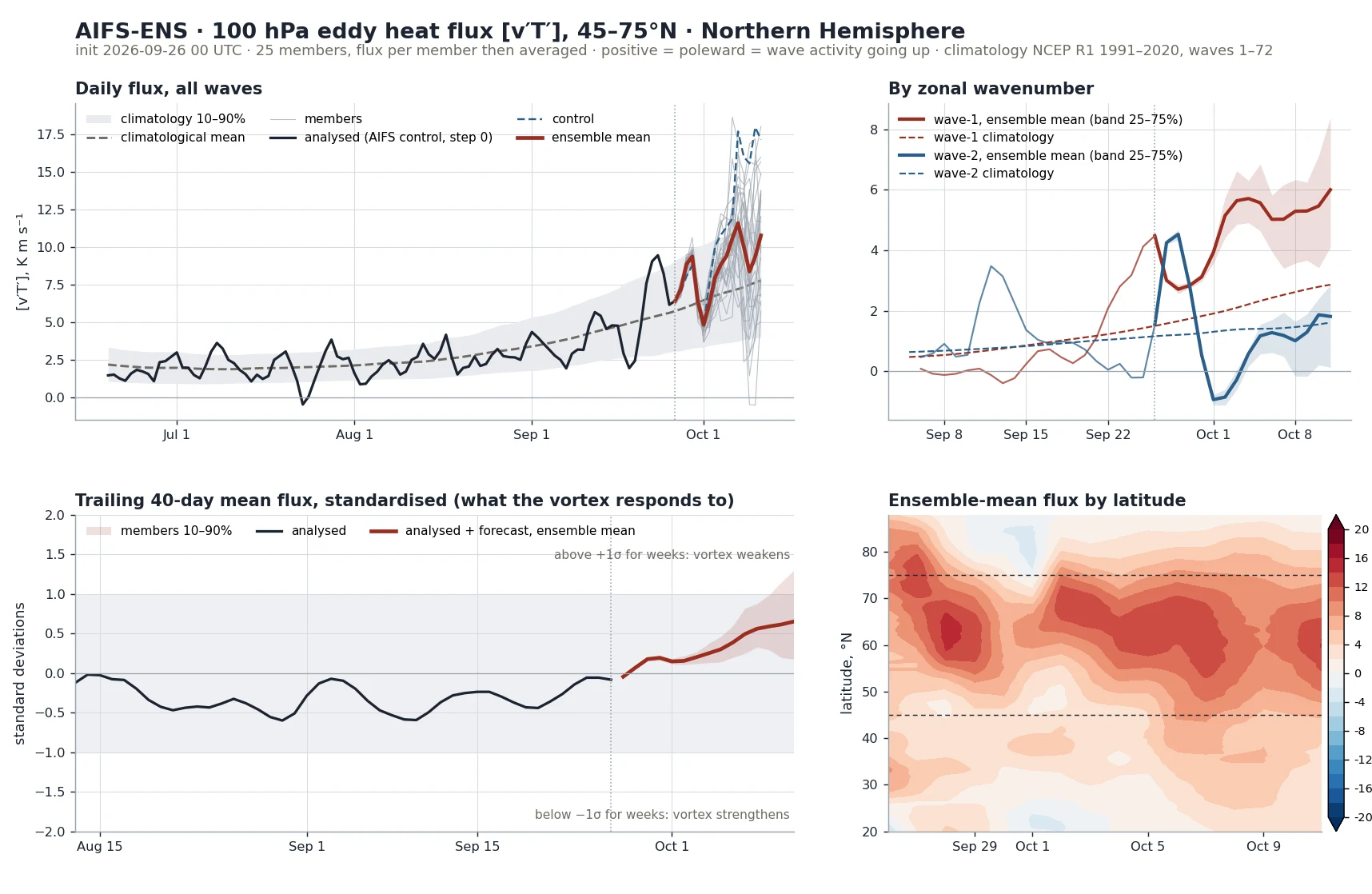
- The vortex responds to the accumulated flux, not to single days. Polvani and Waugh (2004) showed that extremes of the 40-day mean 100 hPa heat flux precede extreme stratospheric events: weeks above normal weaken the vortex, and weeks below normal let it strengthen.
- Averaged over January and February, the 45–75°N heat flux predicts the Arctic stratosphere's temperature in March (Newman et al., 2001), and with it how much ozone survives into spring.
- In early autumn radiative cooling still dominates, so a burst of heat flux slows the vortex's seasonal spin-up rather than reversing it.
The live forecast
The flux is averaged over 45–75° in each hemisphere (positive is poleward in both), computed for the AIFS control and 25 perturbed members and then averaged: like every quadratic diagnostic, the flux of the ensemble-mean fields would fade with lead time. Zonal wavenumbers 1–72 are kept so that the forecast resolves the same eddies as the 1991–2020 NCEP/NCAR reanalysis climatology it is compared with. The panels show the daily flux, its wave-1 and wave-2 parts, the trailing 40-day mean standardized, and the flux by latitude through the forecast.
Open the eddy heat flux on the stratosphere page